
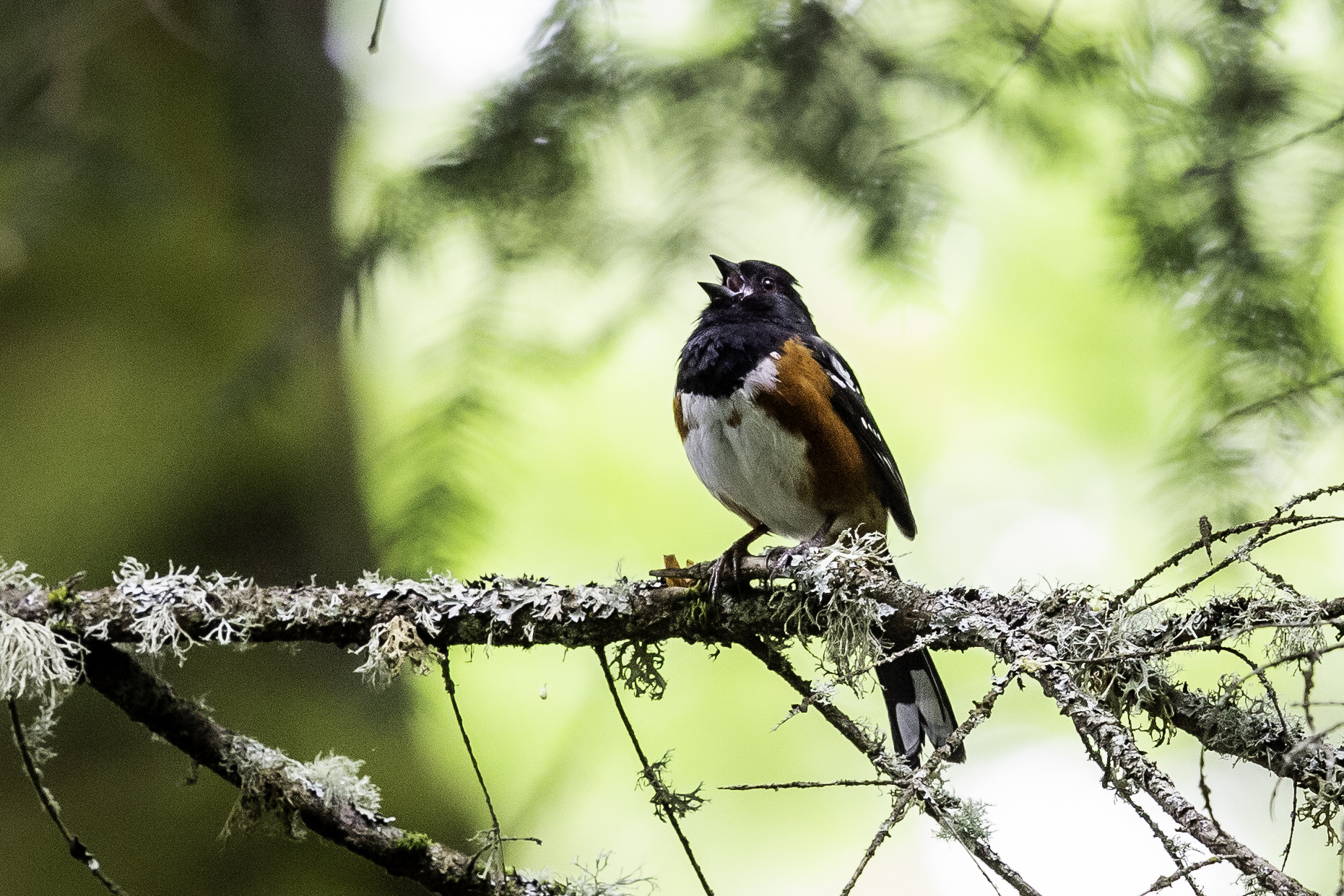
Local Conservation Collaborative Highlighted in New York Times series
The Listen Up Collaborative, a pioneering partnership that uses acoustic bird monitoring to manage for fire and climate resilience and enhance habitat for bird conservation in Western Washington, has been featured in the New York Times’ prestigious “50 States, 50 Fixes” series. The feature highlights how the seven-organization coalition is using affordable technology and proven science to reverse declines in forest bird populations—and inspiring land trusts nationwide to adopt similar methods. The collaborative is one of six Conservation Collaboratives funded by the Cornell Lab of Ornithology’s Land Trust Bird Conservation Initiative (LTBCI).
The Listen Up Collaborative began in 2023 as a partnership between Great Peninsula Conservancy and Jefferson Land Trust, deploying audio recording devices on conserved forest lands. By 2024, the Bainbridge Island Land Trust formally joined the effort, expanding monitoring across Kitsap County. With the addition of a $50,000 grant from Cornell, the Collaborative has now grown into a seven-member coalition monitoring 100 sites across five counties, using small acoustic recorders called AudioMoths to capture more than 400,000 minutes of bird songs and calls. Other partners include Northwest Natural Resources Group, Point No Point Treaty Council, Jamestown S’Klallam Tribe, and Kitsap County Parks.
Acoustic recording devices allow land managers to measure whether restoration practices—like creating wildlife snags, thinning overstocked forests, and planting climate-adapted trees—benefit the 58 bird species the Collaborative tracks, including seven Species of Greatest Conservation Need. Recent data from the project indicate that Swainson’s Thrush vocalizations increased dramatically in restored forest patches, proving that thoughtful intervention helps birds thrive. The Bainbridge Island Land Trust is using acoustic monitors at Manzanita Ridge Preserve and Quitslund Preserve to better understand how restoration of these forests affects biodiversity. The Land Trust is working to restore diverse plant species and increase climate resilience at both sites—particularly at Manzanita Ridge, where we plan to establish a rare oak and wildflower woodland habitat in an area now dominated by invasive plants.
“We have the same habitat challenges on Bainbridge Island as those our partners face on the Kitsap Peninsula—stressed forests with too many similar trees packed together, letting no light through for a healthy understory, and disturbed openings covered in weeds,” says Gina King, Conservation Director at the Bainbridge Island Land Trust. “The Collaborative enables us to test the impacts of shared management strategies for the benefit of collaborators as well as for small forest landowners throughout the region.”
Over 50 percent of western forest birds are in significant decline due to habitat loss and degradation, including simplified forest conditions resulting from industrial timber management practices. The Listen Up Collaborative has enhanced 1,457 acres in 2024 alone, creating 810 wildlife snags, 278 coarse woody debris structures, and planting nearly 4,000 climate-adapted seedlings. On Bainbridge Island, volunteers have played a crucial role in supporting habitat restoration efforts across Land Trust properties like Springbrook Creek Preserve and Manzanita Ridge Preserve. In 2025 alone, volunteers have spent approx. 500 hours pulling invasive species, building habitat features, and installing native plants at semimonthly conservation work parties. So far this year, Land Trust volunteers have removed nearly 2,000 cubic ft of invasive plants like English Ivy and Himalayan Blackberry—roughly the volume of a large school bus.
“We’re thrilled to see the Listen Up Collaborative featured in this New York Times’ series,” says Sara Barker, Director of the Land Trust Bird Conservation Initiative at the Cornell Lab of Ornithology. “This demonstrates how LTBCI’s collaborative model is catalyzing real change through regional partnerships. This Collaborative exemplifies the combination of innovative technology, scientific expertise, and community engagement—elevating our approach to forest restoration and bird conservation and showcasing a model that can be replicated by land trusts nationwide.”
In 2013, the Cornell Lab of Ornithology launched the LTBCI to reach a network of 1,200 land trusts nationwide that collectively protect 61 million acres of private land (more than all national parks in the lower 48 combined). The LTBCI’s Conservation Collaboratives bring neighboring lands trusts together to focus conservation efforts on high-priority birds in the places where protection and management are most needed and can be most effective. Through the LTBCI and the Conservation Collaboratives program, land trusts can access extensive bird-related resources, training, capacity building, and funding opportunities. These Collaboratives enable land trusts and their partners to leverage investments and secure recognition for their work, helping to bring the Cornell Lab’s science to action.
The New York Times’ “50 States, 50 Fixes” series showcases innovative, community-driven climate solutions from across the nation. The Listen Up Collaborative was selected as Washington State’s featured project for its scalable approach, measurable results, and model for cross-organizational collaboration. To read the full article, click here.